A public resource guide
Schedule through the Solid Waste Services Collection Tool on atlantaga.gov, by messaging @ATL311 on social media, or by calling 404-546-0311. Pickup happens on your regular weekly collection day.
Checked October 2026 against official city sources · Maintained by Freemoval as a public resource
If you're reading this, you probably need to get rid of something in Atlanta and you're looking for the cheapest legitimate way to do it. This page covers every option, in order from free to paid, with what each one actually accepts and how to access it.
Start here
What brings you to this page today?
On this page
There are four legitimate ways to get junk removed in Atlanta at no cost: city bulk pickup, donation-pickup programs, the Freemoval partner program, and self-haul to facilities that don't charge tipping fees. Each has eligibility rules, not everyone qualifies for every option. Below is each one with what you need to know.
Freemoval (free pickups through partner organizations)
FreeFreemoval funds free junk removal and cleanouts for households referred by trusted partner organizations, such as nonprofits, housing programs, and senior services. Families don’t apply directly. A partner submits the request and vouches for the need.
Where: Launched in metro Atlanta in 2026 and onboarding its first partner organizations.
How to access: Ask a caseworker, housing counselor, or nonprofit you already work with to submit a request, or use the Get help page to be connected.
What’s covered: One free pickup per household, for junk removal and cleanouts within standard LoadUp marketplace service.
How it’s funded: LoadUp customer round-ups and direct contributions, spent at standard LoadUp rates. The household pays nothing.
City of Atlanta bulk trash pickup
FreeThe City of Atlanta provides scheduled bulk trash pickup for residential sanitation customers as part of standard service. This is the default free option for most single-family Atlanta residents.
Eligibility: Single-family residential customers with active City of Atlanta sanitation accounts. Multi-family properties are typically served by private waste contractors instead.
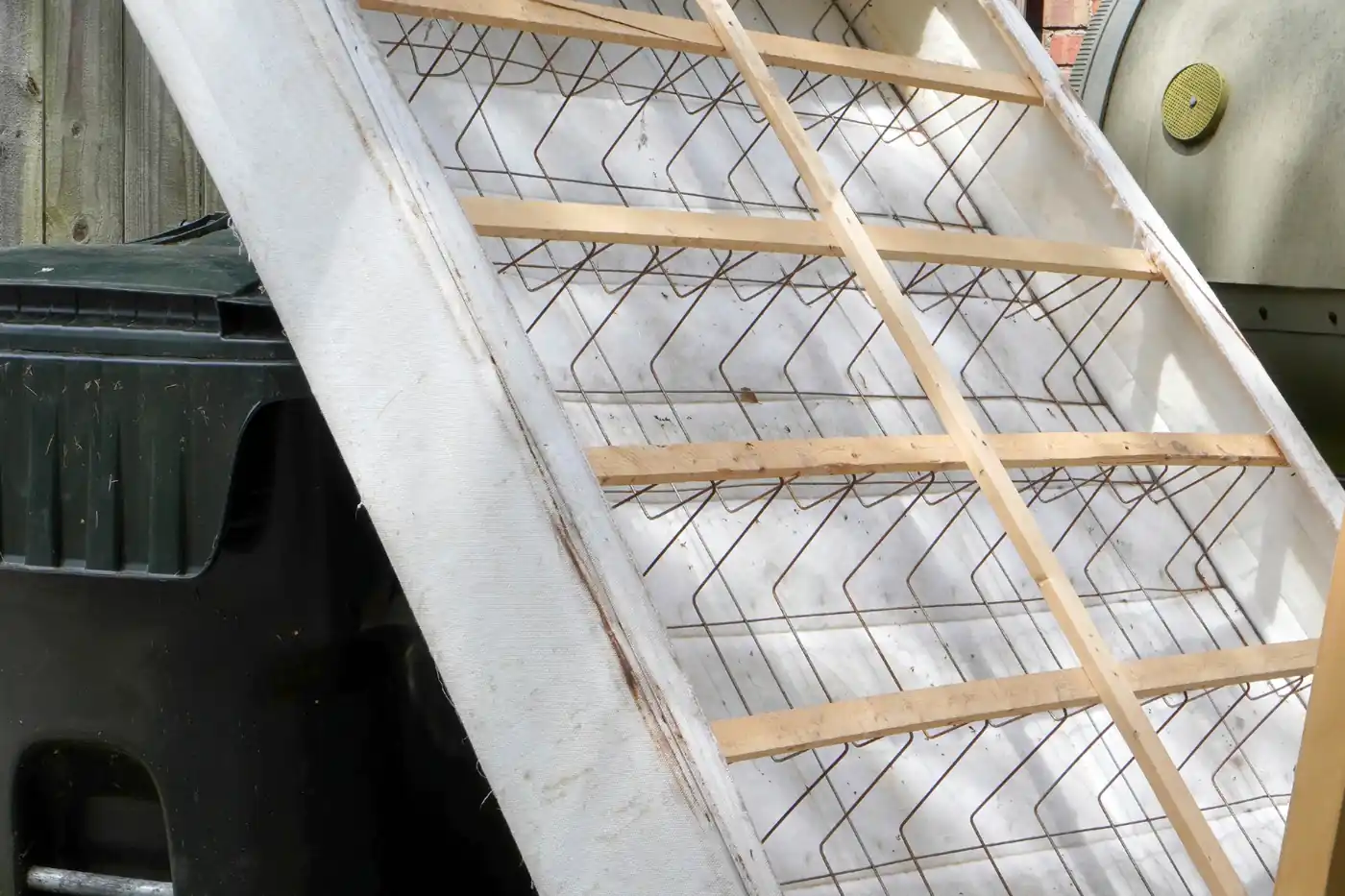
What's accepted: Furniture, mattresses, large household items. Not accepted: refrigerators or appliances with refrigerants (these require separate scheduling), hazardous materials, construction debris, tires, or electronics.
How to schedule: Call 311 (or 404-546-0311 from outside the city), or submit a request at 311.atlantaga.gov. Scheduling typically takes 1 to 2 weeks.
Donation-pickup programs
FreeSeveral Atlanta nonprofits offer free pickup for items in usable condition. This is the right path for furniture, working appliances, and household goods that someone else can use. Items must be clean and functional, broken or damaged items aren't accepted.
Furniture Bank of Metro Atlanta: Free pickup of usable furniture, mattresses, and household items. Schedule online at furniturebankatlanta.org.
Goodwill of North Georgia: Free donation pickup for larger items. Smaller items can be dropped at any of 60+ donation centers across metro Atlanta.
Habitat for Humanity ReStore: Pickup available for furniture, appliances, and home goods in good condition. Schedule via the Atlanta ReStore locations.
The Salvation Army: Free pickup of clothing, furniture, and household items. Call 1-800-SA-TRUCK.
Beyond bulk pickup, the City of Atlanta operates several adjacent services worth knowing about. All are accessed through ATL311 (311 from inside the city, 404-546-0311 from outside, or the online portal at 311.atlantaga.gov).
Bulky item pickup. Up to 10 cubic yards per pickup, scheduled by request. Items must be at the curb by 7 AM on the scheduled date. No additional fee beyond standard sanitation billing.
Yard waste. Collected weekly on regular trash day when bagged or bundled per city specifications. Larger yard cleanups can be scheduled separately through 311.
Recycling. Single-stream curbside recycling is included with sanitation service. The City of Atlanta accepts paper, cardboard, plastic bottles and containers (#1, #2, #5), aluminum, and steel cans. Glass is accepted at drop-off centers but not curbside.
Hazardous waste. The City of Atlanta hosts periodic hazardous waste collection events. Dates and locations are published at atlantaga.gov/government/departments/public-works.
Outside Atlanta city limits. If you're in unincorporated Fulton County, DeKalb County, or surrounding municipalities (Decatur, Sandy Springs, Brookhaven, etc.), services and scheduling differ. Most are operated by private contractors with similar bulk pickup options, check your local government website for specifics.
Donation programs are the right fit for items in usable condition. Most accept: clean upholstered furniture without significant tears or stains, working appliances less than 10 years old, mattresses in good condition (some programs have stricter mattress rules), kitchenware, lamps, and most home goods.
Items donation programs typically don't accept: damaged or stained furniture, mattresses with bedbug history or significant wear, appliances that don't work, particle-board furniture in poor condition, cribs (federal safety regulations have changed), and exercise equipment that requires reassembly.
If you're unsure whether something qualifies, call the program before scheduling. Pickups that arrive and find unacceptable items usually leave them behind, which means you still need to dispose of them.
For items that don't qualify for free programs, or for households outside the city's sanitation service, paid removal options range from self-haul to professional services.
Self-haul to a transfer station
$10-$50If you have a truck or can rent one, transfer stations charge tipping fees by weight or item type. This is the cheapest paid option, but requires you to load, transport, and unload the items yourself.
Live Oak Landfill (DeKalb): Accepts most non-hazardous waste. Tipping fees vary by weight.
Republic Services Honey Creek (Conyers): Construction debris, bulk waste, and most non-hazardous materials.
Pine Ridge Recycling and Disposal (Forsyth): Mixed waste accepted, recycling streams available.
Always call ahead, hours, accepted materials, and fees change. Some facilities don't accept mattresses or specific items at all.
LoadUp paid pickup
$80+For households not eligible for free programs, LoadUp offers professional removal with upfront pricing and same-week scheduling. Independent loaders in the marketplace handle pickup, loading, and licensed disposal.
What's included: Loading, hauling, and licensed disposal. No prep needed beyond pointing out what goes.
Pricing: Starts around $80 for a single item; full-truck pickups range from $300 to $600 depending on volume.
Other paid services in Atlanta: 1-800-Got-Junk, College Hunks Hauling Junk, Junk King, comparison-shop for larger jobs.
If you can pay for a pickup, your booking helps fund free pickups for someone else. Every paid LoadUp customer can opt in to round up at checkout, and 100% of round-ups go directly to Freemoval’s subsidized jobs.
Book a paid pickup with LoadUp → Round-up option appears at checkout. Optional, opt-in only.
Different items have different rules. Here's a quick reference for the most common things people need to dispose of in Atlanta.
Household hazardous waste, paint, motor oil, pesticides, pool chemicals, batteries, fluorescent bulbs, and old electronics with batteries, cannot go in regular trash and shouldn't go to standard transfer stations.
The City of Atlanta hosts hazardous waste collection events several times per year, free for city residents. Dates are announced through ATL311 and the public works department website. Some retailers also offer ongoing free recycling: Home Depot for batteries and CFL bulbs, AutoZone for motor oil and car batteries, Best Buy for electronics, and most pharmacies for unused medications.
Outside the city, Fulton, DeKalb, and Cobb counties run their own periodic hazardous waste events. Check your county's public works or environmental services page for the next scheduled date.
If you see illegal dumping or want to report a dump site, the right channel depends on jurisdiction:
City of Atlanta: Call 311 or submit a report through ATL311 at 311.atlantaga.gov. Include location (cross streets or address), description of dumped material, and a photo if possible. Reports typically get a response within 3 to 5 business days.
Fulton County (outside city limits): Call 404-612-7800 or report through fultoncountyga.gov.
DeKalb County: Use the SeeClickFix mobile app or call 404-294-2900.
Other metro counties: Cobb County (770-528-1102), Gwinnett County (770-822-7141), Clayton County (770-477-3766).
Illegal dumping carries fines of $250 to $1,000 in the City of Atlanta, plus potential cleanup-cost recovery and possible misdemeanor charges for repeat or commercial-scale violations. If you're considering dumping because you can't afford a haul, please use one of the free options above instead, the fines alone exceed what most paid removals cost.
Each guide below takes the Atlanta rules on this page and adds item-specific prep, donation standards, and the free routes that exist outside city programs: mattress, couch, refrigerator, washer and dryer, furniture, tv and electronics, dresser, bed frame and box spring, dishwasher, air conditioner, water heater, hot tub, piano, tires, exercise equipment, desk and office furniture, patio furniture, pool table, carpet and rugs, grill, trampoline and playset, lawn mower, scrap metal, construction debris, yard waste, toilet, bathtub, and sink, moving boxes and cardboard.
Is there really free junk removal in Atlanta?
Yes, there are multiple legitimate free options: scheduled bulk pickup through City of Atlanta sanitation (for residential customers), donation-pickup programs through Furniture Bank, Goodwill, Habitat ReStore, and Salvation Army (for usable items), and Freemoval (for households referred by a partner organization). Each has eligibility rules, not everyone qualifies for every program, but most Atlanta residents qualify for at least one.
How do I qualify for Freemoval?
Freemoval works through partner organizations rather than direct applications. If a nonprofit, housing program, senior service, or caseworker is already helping you, ask them to submit a Freemoval request on your behalf. The partner vouches for the need, so there is no income paperwork. If you aren't connected to an organization, use our Get help page and we will try to connect you with a partner in metro Atlanta. Freemoval launched in metro Atlanta in 2026 and is onboarding its first partner organizations. If you work at a nonprofit, see the For partners page.
What's the cheapest way to get rid of a mattress in Atlanta?
If you're a City of Atlanta sanitation customer, schedule a free bulk pickup through 311. If the mattress is in good condition, Furniture Bank of Metro Atlanta offers free pickup. If neither applies, transfer stations accept mattresses for $10-$25, and paid hauling services start around $80 for a single mattress pickup.
Why doesn't my apartment building have bulk pickup?
Most multi-family properties in Atlanta use private waste contractors, not city sanitation, so the city's free bulk pickup doesn't apply. Your property's contracted hauler may or may not include bulk service, ask your property manager. This gap is exactly why Freemoval exists: residents of multi-family low-income housing typically have the fewest free options, even though they're where dumping volume is highest.
What happens if I just put a couch on the curb?
In the City of Atlanta, items at the curb without a scheduled bulk pickup are treated as illegal dumping, with fines starting at $250. The curb pickup is free, but it has to be scheduled, typically 1 to 2 weeks in advance through 311. If you need same-week disposal, use a donation pickup, Freemoval (if eligible), or a paid service.
Do landlords have to provide bulk pickup?
Georgia state law doesn't require landlords to provide bulk pickup specifically. They're required to maintain habitable conditions and reasonable trash service, but bulk waste handling varies by lease terms and property contract. If your property doesn't offer it, ask whether they'd consider partnering with Freemoval through the For partners page.
I'm moving out and have a lot of stuff. What's the best plan?
For move-outs, the cheapest sequence is usually: (1) Donate everything in usable condition through a single donation pickup, most programs take multiple items at once. (2) Schedule city bulk pickup for the rest if you're a residential customer. (3) For anything left, use Freemoval if eligible, or a paid hauler. Plan ahead by 2 to 3 weeks, donation pickups and bulk schedules both have wait times.
Is this page maintained?
Yes. Freemoval maintains this page as a public resource. We update it when programs change rules, fees, or contact methods. Last checked October 2026. If you find outdated information, let us know.
Freemoval funds free pickups for households referred by partner organizations and is onboarding its first partners in metro Atlanta. Reach out to start the conversation.
Start a partnership conversation