The problem
Cities clean it up. Codes try to punish it. Cameras try to catch it. None of it addresses the moment of friction where the dumping actually happens.
There is no single national database of illegal dumping costs. The data lives in scattered municipal budgets and audits, but the scale is clear wherever a city has counted. Philadelphia’s City Controller reported in September 2026 that illegal dumping costs the city nearly $9 million a year, after crews cleaned up almost 14,000 tons of dumped material in fiscal year 2025. Seattle budgeted more than $1.8 million for illegal dumping in 2023. A Pennsylvania statewide study puts the cost of cleaning up a dump site at about $619 per ton once labor, equipment, and disposal are counted.
Those numbers don’t capture the indirect costs: property value depreciation in affected neighborhoods, code enforcement labor, environmental remediation when dumping includes hazardous materials, and the public health costs of pests that breed in dumped material.
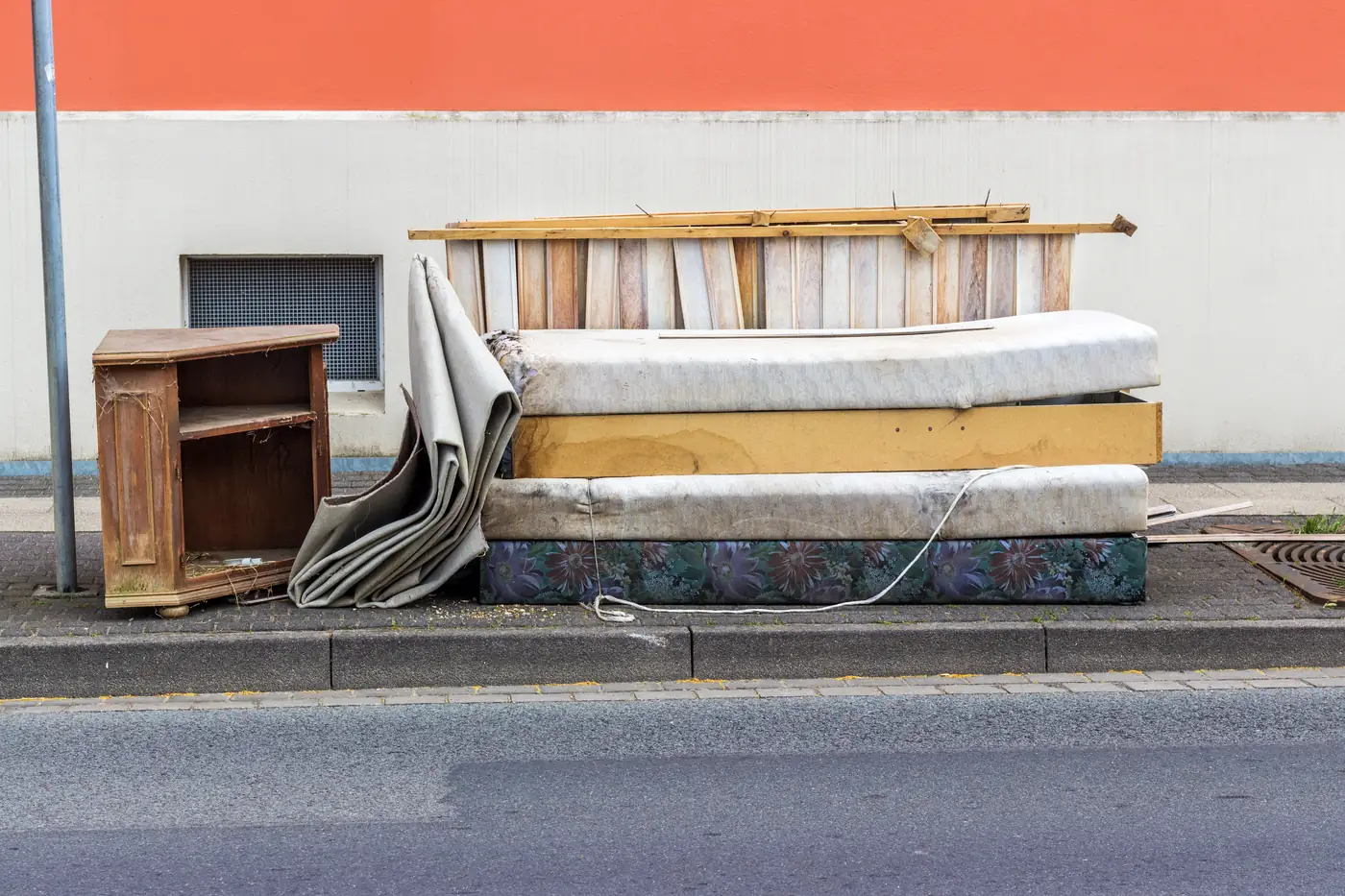
Illegal dumping is geographically concentrated. City cleanup programs consistently report the same hot spots: alleys, vacant lots, and the streets around dense rental housing. The items cities report most often are furniture, mattresses, TVs and electronics, tires, and construction debris, which are exactly the items that are hardest for a household without a truck to get rid of legally.
The pattern
A couch left in an alley is rarely a vandalism decision. It is usually a logistics failure: a household that needed something gone, had no truck, no budget, and no simple legal option that week.
Surveillance. Cameras at known dump sites move the dumping somewhere else. They don't reduce total volume; they redistribute it. Cleanup crews describe the same thing over and over: clear a site and a new one appears nearby.
Fines and enforcement. Code citations require identifying the dumper, which happens in a tiny fraction of incidents. Even when a citation is issued, collection rates are low and the citation rarely changes future behavior because it doesn't address the underlying friction.
Public service announcements. “Don't dump” campaigns assume the dumper has a viable alternative they're choosing not to use. For most multi-family low-income households, the alternative, renting a truck, finding a transfer station, paying tipping fees, doesn't exist.
Bulk pickup days. Cities that offer scheduled bulk pickup see meaningful incident reduction, but the program is usually capped (one pickup per household per year), seasonal, and underutilized in exactly the geographies that need it most because of awareness gaps.
Every approach above is demand-side: trying to discourage, monitor, or redirect the dumper. The supply-side approach is simpler: make removal accessible at the moment the household needs it. If a free or near-free pickup is available the same week the resident is moving out, the dumping doesn't happen.
This isn't hypothetical. It's how comparable problems get solved when the supply side is properly resourced. Needle exchange programs reduced public discarding by making safe disposal accessible. Curbside recycling reduced landfill volume by removing the friction of separate disposal. The pattern is consistent: friction is the failure, and supply-side intervention fixes it.
Freemoval is the supply-side hypothesis for illegal dumping. The thesis: when a trusted partner organization can get a family a free pickup the week they need it, the couch never ends up in the alley. Freemoval launched in metro Atlanta in 2026 and plans to expand nationwide as partner organizations and funding grow.
If the model works, it scales. If it doesn’t, we will say so and change it. Being plain about what is and isn’t working is the only way a program like this earns trust.
We're happy to share data, methodology, and on-the-record briefings with journalists, academics, and policy researchers.
For press & researchers