A public resource guide
What counts as illegal dumping, why it happens, state and federal penalties, how to report it, and what communities can do about it.
Last updated: May 2026 · Maintained by Freemoval as a public resource
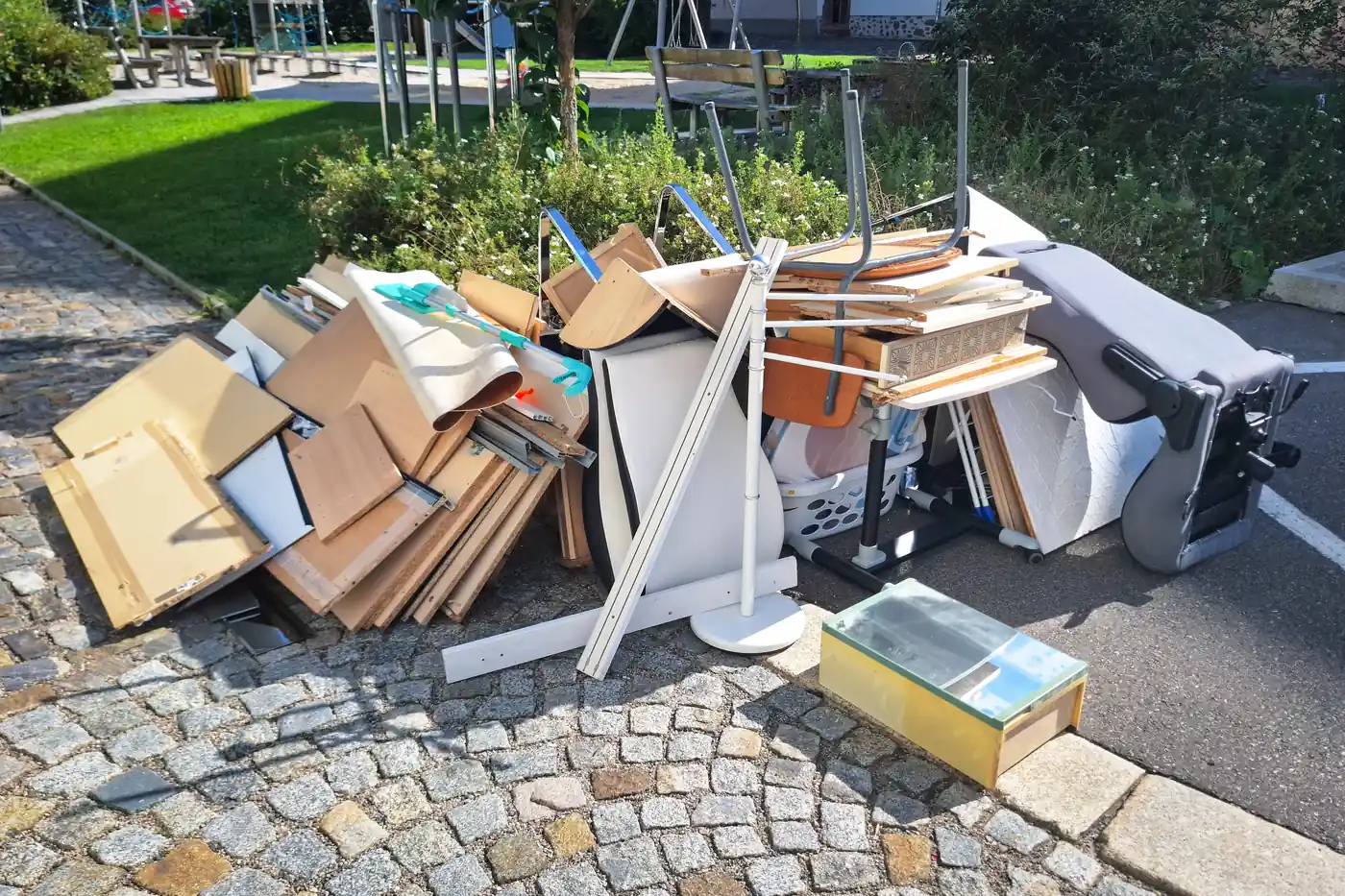
Illegal dumping is the unauthorized disposal of waste, furniture left on the side of a road, mattresses abandoned in alleys, construction debris dropped on vacant lots, appliances dumped in parks. Federal and state laws prohibit it everywhere in the United States. It costs U.S. cities and counties an estimated billions of dollars annually in cleanup, lost property value, and environmental remediation. It disproportionately affects low-income neighborhoods. And it’s usually preventable, because almost every type of waste has a legal free disposal path that most people simply don’t know about. This guide is a comprehensive reference for residents, community organizations, journalists, and policy makers who want to understand the problem and what can be done about it.
On this page
Illegal dumping, sometimes called open dumping, fly-tipping (the British term, often used in academic literature), or unauthorized disposal, is the placement of waste in any location not licensed or permitted to receive it. The legal category is broad and includes:
· Roadside dumping. Furniture, mattresses, appliances, or bagged trash left on roadsides, shoulders, or rights-of-way.
· Vacant lot dumping. Construction debris, household items, or commercial waste deposited on undeveloped or abandoned property without the owner’s consent.
· Public space dumping. Waste left in parks, alleys, public parking lots, or behind commercial buildings.
· Donation drop-off site dumping. Items left outside closed Goodwill, Salvation Army, or other donation centers when staff aren’t present. Even though items may be intended for donation, abandoning them outside hours violates most local ordinances.
· Waterway and storm drain dumping. Disposal of any waste, even seemingly benign items like grass clippings or used motor oil, into rivers, lakes, drainage ditches, or storm drains.
· Commercial dumping. Unlicensed contractors or haulers depositing waste in unauthorized locations rather than paying tipping fees at licensed landfills or transfer stations.
· Burn-pile dumping. Setting fire to waste in unauthorized locations, which is illegal in most U.S. jurisdictions even on private property.
The category applies regardless of whether the waste is hazardous. A discarded couch counts as illegal dumping just as much as an abandoned barrel of motor oil, though the penalties for hazardous materials are typically much higher.
Research from the U.S. EPA, state environmental agencies, and academic studies consistently identifies several primary drivers:
High disposal costs relative to household budget. Paid junk removal services in most U.S. metros run $80–$200+ for a single bulky item and $200–$2,000+ for whole-house cleanouts. For households with limited cash flow, seniors on fixed incomes, families experiencing financial hardship, low-income tenants, this represents a real barrier. When the legal options cost more than the household can absorb, some people will choose illegal disposal even knowing the risks.
Gaps in city bulk pickup service. Some U.S. cities offer no free bulk pickup at all (San Diego is a notable example). Others offer free pickup only by appointment with weeks of wait time, or with strict item-count limits, or only in certain neighborhoods. When the legal free path requires a 4-week wait and the household needs the item gone before a move-out date, people make decisions they wouldn’t otherwise make.
Lack of awareness about free options. Many residents don’t know their city offers free bulk pickup, that retailer haul-away with new appliance delivery is free, that donation programs pick up usable furniture for free, or that state mattress recycling programs (CT, RI, CA, OR) accept mattresses free at participating sites. The information exists but isn’t aggregated in one place, which is part of why our by-item disposal guides exist.
Commercial dumping by unlicensed haulers. A significant portion of large-scale illegal dumping is commercial, unlicensed “haulers” collect disposal fees from residential or commercial clients and then dump the waste in vacant lots or rural areas to avoid paying landfill tipping fees. This is fraud as well as environmental crime, but it’s difficult to detect and prosecute. Many jurisdictions are increasing license verification and surveillance to address this.
Geographic concentration in disadvantaged areas. Illegal dumping is dramatically more frequent in low-income neighborhoods, communities of color, and under-resourced areas. The reasons are layered: lower property values mean less aggressive enforcement, fewer cameras and surveillance, less political pressure, and a feedback effect where existing dumping signals to potential dumpers that the location is “available.” Environmental justice research consistently documents this disparity.
Illegal dumping is illegal at the federal, state, and local level. Penalties vary significantly by jurisdiction, type of waste, volume dumped, and whether the offender is a first-time or repeat violator.
The Resource Conservation and Recovery Act (RCRA) of 1976 governs federal hazardous waste regulation. RCRA violations can result in civil penalties up to $50,000 per day per violation, and criminal penalties including imprisonment for knowing violations. The Clean Water Act adds additional penalties for waste dumped in or near waterways. The federal government typically enforces against large-scale or hazardous-waste dumping; smaller residential dumping is handled at the state and local level.
Every U.S. state has solid waste laws that prohibit illegal dumping. Civil penalties typically range from $500–$10,000 for first-time offenses involving non-hazardous waste, scaling up to $25,000+ for hazardous waste violations or repeat offenses. Some states impose criminal penalties including jail time for large-scale or repeated dumping. Most states also require offenders to pay cleanup costs, which often exceed the fine itself, a single illegal dump cleanup can cost $1,000–$10,000 depending on volume and contamination.
Selected state penalty examples (subject to change):
· California: Penal Code 374 imposes fines up to $1,000 for first offense, up to $3,000 for third offense, plus up to 6 months in jail. Vehicle impoundment available for offenders using a vehicle to dump.
· Texas: Health and Safety Code Chapter 365 imposes fines from $500 to $4,000+ depending on volume, with criminal penalties up to 2 years in jail for over 1,000 lbs dumped.
· Georgia: O.C.G.A. 16-7-43 imposes fines from $500 to $25,000 plus possible imprisonment for litter and dumping violations, with higher penalties for hazardous waste.
· New York: Environmental Conservation Law imposes civil penalties up to $15,000 per day, with criminal penalties for willful violations.
· Florida: Statutes 403.413 imposes fines up to $50,000 for commercial dumping, with imprisonment up to 5 years for hazardous waste violations.
For your specific state’s laws, search “[your state] illegal dumping penalty” or contact your state environmental agency.
City and county ordinances add another layer of enforcement, often with civil penalties from $250–$2,500 for first violations and escalating for repeats. Many municipalities also charge cleanup costs and may impose code enforcement liens on property where dumping occurs. Some cities operate dedicated environmental crimes units that pursue larger cases.
Reporting illegal dumping is one of the highest-leverage actions individual residents can take. Most cities have well-established reporting channels, and reports often result in cleanup, citation, and sometimes prosecution.
In most U.S. cities, dialing 311 connects you to a local services hotline that routes illegal dumping reports to code enforcement, solid waste, or public works. 311 is available in over 300 U.S. cities including New York, Chicago, Los Angeles, Houston, Phoenix, Philadelphia, San Antonio, San Diego, Dallas, Austin, Jacksonville, Fort Worth, Columbus, Charlotte, Indianapolis, San Francisco, Seattle, Denver, Washington DC, Boston, Nashville, Memphis, Portland, Oklahoma City, Las Vegas, Louisville, Baltimore, Milwaukee, Albuquerque, Tucson, Fresno, Sacramento, Kansas City, Atlanta, Long Beach, Miami, Raleigh, Omaha, Minneapolis, Cleveland, Tulsa, Wichita, Arlington, New Orleans, and many others.
Most 311 systems also offer mobile apps and online reporting portals. NYC’s 311, LA’s MyLA311, and Chicago’s 311 are particularly well-developed.
Cities without 311 typically have direct numbers for code enforcement, solid waste, or public works. Search “[your city] illegal dumping report” for the right contact. Many cities also have neighborhood services apps (e.g., GORequest, SeeClickFix) that route reports to the appropriate department.
For larger-scale dumping, hazardous waste, or commercial dumping, state environmental protection agencies have dedicated reporting lines:
· California: CalRecycle illegal dumping report line
· Texas: TCEQ environmental complaint line
· Georgia: Georgia EPD environmental complaint line
· New York: DEC environmental conservation officer hotline
· Florida: Florida DEP environmental complaint line
Search “[your state] environmental complaint” for current contact information.
For dumping on federal land, dumping involving large volumes of hazardous waste, or interstate dumping, contact the EPA at epa.gov/report-spill or the National Response Center at 1-800-424-8802.
If you witness dumping actively in progress, call your local non-emergency police line (or 911 in genuine emergencies). Police can dispatch an officer to investigate, document license plates, and pursue criminal charges. Don’t confront dumpers directly, commercial dumpers in particular have been known to respond with violence when intercepted.
Reports with the following information have dramatically higher rates of enforcement action:
· Photos with timestamps, cell phone photos with embedded location and date metadata are admissible evidence in many jurisdictions.
· License plate numbers, if you witnessed the dumping, the plate is the single most valuable piece of evidence. Note the make, model, and color of the vehicle as well.
· Specific location, street address, cross streets, or GPS coordinates. Vague locations slow response.
· Description of waste, type of items, approximate volume, whether it appears commercial (uniform packaging suggests construction debris) or residential.
· Date and time, especially important if you witnessed the dumping rather than discovered it after the fact.
· Photos showing identifying information, mail with addresses in dumped trash, business labels on packaging, and other clues that can identify the source. Many illegal dumpers don’t realize they leave evidence in the waste itself.
Effective community responses to illegal dumping combine four pillars:
Surveillance cameras at known dumping hotspots have demonstrably reduced incidence in cities that have deployed them strategically. License plate recognition (LPR) systems, increasingly affordable for municipalities, allow rapid identification of repeat dumpers. Some cities have deployed mobile surveillance trailers that can be redeployed as dumping patterns shift. Consistent enforcement, following through on citations, prosecuting clear cases, and publicizing outcomes, matters more than single high-profile actions.
Cities that offer robust free bulk pickup programs see less illegal dumping than cities that don’t. Specific approaches that work: weekly free bulk pickup with no appointment required (Buffalo, Knoxville, Houston); generous twice-yearly area-rotation programs (Tucson’s Brush & Bulky Plus); fee-waived special pickups for residents who can demonstrate hardship; mobile collection events scheduled into underserved neighborhoods; and operational collaboration with subsidized pickup programs (which is part of what Freemoval is trying to do).
Many residents who dump illegally simply don’t know what free options exist. Cities that invest in clear public information, multilingual flyers, social media campaigns, door-to-door outreach in high-incidence neighborhoods, point-of-sale messaging at retailers, see meaningful behavior change. The information has to be accurate, locally specific, and easy to find at the moment of need.
The “broken windows” effect is well-documented in illegal dumping research: sites that get cleaned within 24–48 hours of a dump report are dramatically less likely to attract repeat dumping. Sites left for weeks or months become magnets for additional waste. Cities that prioritize rapid cleanup as part of their solid waste budget, rather than treating it as an unfunded burden, consistently see better outcomes.
Community organizations and neighborhood associations can play significant roles in all four pillars. Neighborhood-led photo documentation, organized cleanup events, advocacy for camera deployment, and partnerships with local code enforcement multiply municipal capacity in measurable ways.
Almost every type of waste has a legal free disposal path. The reason illegal dumping persists isn’t usually that legal options don’t exist, it’s that people don’t know about them. The most universal options:
City curbside bulk pickup. Most U.S. cities offer free bulk pickup of furniture, mattresses, appliances, and large household items. Schedules and rules vary, some weekly, some monthly, some twice-yearly, but the option exists in nearly every metro. Find rules for your city.
Donation pickup. Salvation Army, Habitat for Humanity ReStore, Goodwill, and Furniture Banks offer free pickup of usable furniture and household items in 50+ U.S. metros. Schedule online or by phone, typically 1–2 weeks out.
Retailer haul-away. Most appliance and mattress retailers include free old-item haul-away with new-item delivery. Some furniture retailers do too. Always ask at purchase.
Free electronics recycling. Best Buy accepts most electronics free at customer service desks (1,000+ U.S. locations). State e-waste programs in 25+ states accept TVs, computers, and electronics free.
Free hazardous waste disposal. Most U.S. cities operate free HHW facilities or periodic collection events. Auto parts stores accept motor oil and lead-acid batteries free. Pharmacies accept old medications.
Subsidized pickup programs. Programs like Freemoval offer subsidized pickup for households who genuinely can’t afford paid hauling. Learn about Freemoval’s subsidized pickup program.
For a complete breakdown of free disposal options by item type, see our by-item disposal guides.
What counts as illegal dumping?
Illegal dumping (also called open dumping or fly-tipping) is the disposal of waste in any location not licensed or permitted to receive it. This includes leaving furniture or appliances on the side of the road, dumping construction debris on vacant lots, abandoning waste in alleys or parks, leaving items at closed donation sites, and dumping into waterways or storm drains. It applies regardless of whether the waste is hazardous.
What are the penalties for illegal dumping?
Penalties vary widely by state and amount of waste dumped. Most states impose civil fines from $500 to $10,000 for first-time small-scale dumping, with criminal penalties including jail time for repeat offenders or large-scale dumping. Federal penalties under the Resource Conservation and Recovery Act can reach $50,000 per day for hazardous waste violations. Many states also require offenders to pay cleanup costs, which often exceed the fine itself.
How do I report illegal dumping?
In most U.S. cities, dial 311 to report illegal dumping to your local code enforcement or solid waste authority. Many cities also have dedicated reporting hotlines or online portals. For dumping on federal land, contact the EPA at epa.gov/report-spill. For dumping that’s actively in progress, call your local non-emergency police line. Photos with timestamps and license plate numbers (if available) significantly improve enforcement outcomes.
Is leaving items at a closed donation site illegal dumping?
Usually yes. Most local ordinances classify items left outside donation centers when staff aren’t present as illegal dumping, even though the items are intended for donation. The legal reasoning: items left unattended often get rained on, stolen, or scattered, creating cleanup burden for the donation center. If you want to donate, schedule a pickup or drop off during open hours.
Why does illegal dumping happen?
Research and field reports identify several primary drivers: high disposal costs (paid hauling at $80–$200+ creates a financial barrier for low-income households), gaps in city bulk pickup service (some cities offer no free bulk option, others have long wait times), lack of awareness (many residents don’t know what free options exist), and intentional commercial dumping by unlicensed haulers and contractors who collect disposal fees from clients but never pay tipping fees at landfills.
What can communities do about illegal dumping?
Effective community responses combine enforcement (cameras at known dumping sites, license plate recognition, increased patrols), accessibility (free or subsidized pickup programs, expanded bulk pickup schedules, mobile collection events), education (clear public information about free disposal options), and rapid cleanup (the broken windows effect, sites that get cleaned within 24–48 hours of a dump report are dramatically less likely to attract repeat dumping).
Is this page maintained?
Yes. Freemoval maintains this page as a public resource. We update it when laws change or when new information becomes available. Last updated May 2026. If you find outdated information, let us know.
Freemoval is a social impact program that subsidizes free junk removal for households who genuinely can’t afford paid hauling. If high disposal costs are part of why you’re considering illegal dumping, please reach out instead.