A public resource guide
No scheduling. Set the item at the curb the evening before the right collection day for your address.
Checked October 2026 against official city sources · Maintained by Freemoval as a public resource
NYC underwent the biggest sanitation transformation in decades over the last two years, bulk pickup appointments were eliminated in favor of a no-scheduling system (set out up to 6 large items on your trash day), citywide composting became mandatory in April 2025, and the official NYC Bin will be required for buildings with 1-9 units starting June 2026. Mattresses must be in clear plastic bags and securely sealed to prevent bedbug spread, this is enforced. Special handling is required for Freon appliances and electronics. This page walks through every legitimate option in order from free to paid.
Start here
What brings you to this page today?
On this page
NYC residents have free curbside bulk pickup with no appointment (up to 6 large items per collection day), free electronics and HHW disposal at SAFE Disposal Events, mandatory curbside composting citywide, and donation pickup programs. The NYC Department of Sanitation (DSNY) operates the world's largest urban sanitation system, 59 district garages, 2,000+ collection trucks, serving 8.5+ million residents.
Curbside large item pickup (no appointment, max 6 items)
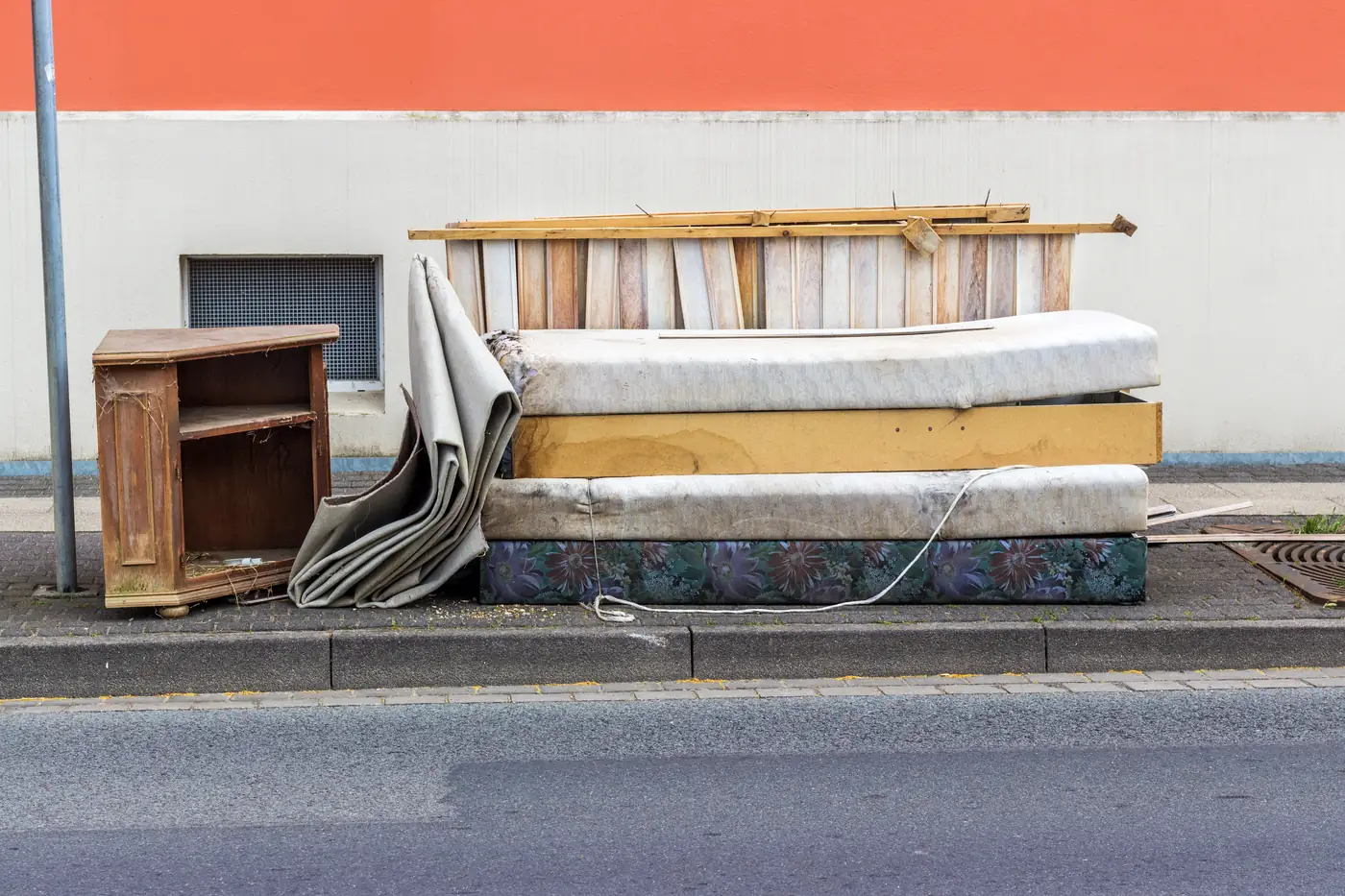
Free with serviceNYC residents get free curbside removal of large items with NO appointment needed. Set out up to 6 items at the curb per collection day. Pickup appointments are no longer offered as of 2024, this is the new system. Place items where you normally put trash, on your trash-only day (NOT your recycling day) for non-recyclable bulk items.
Eligibility: NYC residents served by DSNY.
Limit: Up to 6 large items per collection day. No appointments, just put items out.
Which day: Non-recyclable items: set out on your trash-only day. Recyclable bulk items (metal furniture, etc.): can go on recycling day.
Set-out time: After 6 PM (in bins) or after 8 PM (in bags) the night before. Materials must be at curb by midnight to ensure pickup.
Mattress rule: Must be fully contained within a clear plastic bag and securely sealed to prevent bedbug spread. This is enforced.
Special handling required: Freon appliances (fridges, freezers, ACs) and electronics need special pickup or drop-off, cannot go out with regular bulk.
SAFE Disposal Events & e-waste pickup
Free for residentsNYC hosts SAFE (Solvents, Automotive, Flammable, Electronics) Disposal Events throughout the year for hazardous waste, electronics, and hard-to-recycle items. DSNY also offers free electronics recycling pickup for buildings with 10+ units through ecycleNYC, and curbside electronics pickup for smaller buildings.
What's accepted: Electronics (TVs, computers, phones, peripherals), batteries, paint, household chemicals, motor oil, fluorescent bulbs, mercury items.
How to use: Find SAFE Disposal Events on the DSNY website. ecycleNYC for buildings with 10+ units (free, ongoing).
Special note: NYC bans e-waste from regular trash. Putting electronics in the trash can result in fines.
Curbside composting (mandatory)
Free with serviceNYC operates the world's largest curbside composting program, diverting approximately 6 million pounds of organic material from landfills weekly. As of April 1, 2025, separating leaf and yard waste, food waste, and food-soiled paper from trash is mandatory citywide. Fines apply for non-compliance.
What's accepted: All food scraps (fruits, vegetables, meat, bones, shells, dairy, cooked food, expired food), food-soiled paper (pizza boxes, paper napkins, paper plates, paper towels), leaf and yard waste.
When collected: Weekly on your recycling day.
Fines: Up to $300 for non-compliance. Buildings with 4+ units are currently subject to fines; enforcement expected to expand to all buildings.
Containers: DSNY brown compost bin or any labeled lidded bin 55 gallons or less. Can line with clear plastic, paper, or compostable bags.
Freemoval (free pickups through partner organizations)
FreeFreemoval funds free junk removal and cleanouts for households referred by trusted partner organizations, such as nonprofits, housing programs, and senior services. Families don’t apply directly. A partner submits the request and vouches for the need.
Status in New York: Not yet available. Freemoval currently serves metro Atlanta and plans to expand nationwide.
How it works where it operates: One free pickup per household, for junk removal and cleanouts within standard LoadUp marketplace service. Funded by LoadUp customer round-ups and direct contributions, spent at standard LoadUp rates.
If you run a nonprofit or housing program in New York: you can start the conversation now through the For partners page.
Donation-pickup programs
FreeNYC-area nonprofits offer free pickup for items in usable condition.
Housing Works: NYC-based nonprofit. Free pickup of furniture, books, clothing in good condition. Schedule at housingworks.org.
The Salvation Army: Free pickup of clothing, furniture, household items. Schedule at satruck.org or call 1-800-SA-TRUCK.
Habitat for Humanity ReStore: NYC-area locations. Pickup for furniture, appliances, building materials.
Big Reuse: Brooklyn and Queens. Pickup of building materials, furniture, appliances.
The Trash Revolution. NYC is in the middle of the biggest sanitation transformation in decades. The major changes: (1) Mandatory containerization, since November 12, 2024, buildings with 1-9 residential units must place trash in bins 55 gallons or less with secure lids; starting June 1, 2026, those buildings must use the official NYC Bin specifically. (2) Mandatory composting, citywide since April 2025. (3) No more bulk appointments, just put up to 6 items out per collection day. (4) Larger building containerization, properties with 31+ units will move to stationary on-street containers serviced by automated side-loading trucks.
NYC Bin requirement. Available for about $50 at all NYC-area Home Depot locations, at bins.nyc, or by delivery via Instacart, DoorDash, and Uber Eats. Fines for non-compliance: $50 first offense, $100 second, $200 third and beyond.
Multi-stream collection. NYC separates residential waste into three distinct streams: trash (gray/black NYC Bin), recycling split into paper/cardboard (green bin) and metal/glass/plastic/cartons (blue bin), and compost (brown bin or labeled bin). Trash collected 2-3 times per week by address. Recycling collected 1-2 times per week. Compost collected weekly on your recycling day.
Set-out times matter. After 6 PM (bins) or 8 PM (bags) the night before. Setting out trash too early is a violation, with active ticketing in 2026 especially in containerization compliance areas. All materials must be curbside by midnight.
Mattress bedbug rule. Any mattress or box spring set out for collection must be fully contained within a clear plastic bag and the bag must be securely sealed to prevent the spread of bed bugs. This is the most strictly enforced bulk rule in NYC.
12 holidays per year. DSNY recognizes 12 official holidays in 2026 with no collection on the holiday day. Collection delays may continue through the end of the holiday week. Holidays: New Year's Day, MLK Day, Presidents' Day, Memorial Day, Juneteenth, Independence Day, Labor Day, Indigenous Peoples' Day, Veterans Day, Thanksgiving, Christmas.
Address-specific schedules. NYC schedules are determined by address, not borough. Use the official lookup tools at nyc.gov/dsny or the DSNY Trash app to confirm your specific collection days. Even buildings on the same block can have different schedules.
Composting mandate ($300 fines). All NYC residents are required by law to separate compostable materials from trash. Buildings with 4+ units are currently subject to fines; enforcement is expanding to all buildings. Even during the temporary enforcement pause announced in late 2024, composting remains mandatory.
NYC Department of Sanitation (DSNY). Call 311 for service requests. Visit nyc.gov/sanitation. The largest urban sanitation system in the world.
New York's donation programs accept items in good usable condition: clean upholstered furniture without significant tears or stains, working appliances less than 10 years old, mattresses in good condition (subject to program-specific rules), kitchenware, lamps, and most household goods.
Items typically not accepted: damaged or stained furniture, mattresses with bedbug history or significant wear, appliances that don't work, particle-board furniture in poor condition, cribs (federal safety regulations have changed), and exercise equipment that requires reassembly. Always call before scheduling if you're unsure, pickups that find unacceptable items will leave them behind.
For households who exceed 6 large items per collection day, can't wait until next collection, need same-day pickup, or have items DSNY won't take (large construction debris), paid options are available. NYC has the largest junk removal market in the country with extensive competition.
LoadUp paid pickup
$80+For households who need same-day or next-day service, exceed 6 items per collection day, or need items DSNY won't take, LoadUp offers professional removal across all five boroughs with upfront pricing. Independent loaders in the marketplace handle pickup, loading, and licensed disposal.
What's included: Loading, hauling, and licensed disposal. No prep needed beyond pointing out what goes.
Pricing: Starts around $80 for a single item; full-truck pickups range from $300 to $700 depending on volume. NYC pricing trends slightly higher due to parking, traffic, and disposal costs.
Other paid services in NYC: 1-800-Got-Junk, College Hunks Hauling Junk, Junk King, plus dozens of local NYC haulers, comparison-shop for larger jobs.
If you can pay for a pickup, your booking helps fund free pickups for someone else. Every paid LoadUp customer can opt in to round up at checkout, and 100% of round-ups go directly to Freemoval’s subsidized jobs.
Book an NYC pickup with LoadUp → Round-up option appears at checkout. Optional, opt-in only.
Different items have different rules in New York. Here's a quick reference for the most common things people need to dispose of.
NYC hosts SAFE (Solvents, Automotive, Flammable, Electronics) Disposal Events throughout the year for residents to dispose of hazardous waste, electronics, batteries, paint, motor oil, and fluorescent bulbs free of charge. Several retailers also offer ongoing free recycling: Home Depot for batteries and CFL bulbs, AutoZone for motor oil and car batteries, Best Buy for electronics, and most pharmacies for unused medications. Lithium-ion batteries are an especially serious concern in NYC, they cause fires inside collection trucks and at sorting facilities. Never put any battery in regular trash or recycling.
To report illegal dumping in NYC, call 311 or use NYC 311 online. DSNY operates an Illegal Dumping Reward Program, report an illegal dumper and you may be eligible for a financial reward. Reports can also be filed via the NYC 311 mobile app. Include the location, description of dumped material, and a photo if possible. NYC takes illegal dumping seriously, with active enforcement and substantial fines. If you're considering dumping because you exceed the 6-item curbside limit, please use a paid hauler, LoadUp pickups starting around $80 are dramatically cheaper than dumping fines (which routinely exceed $1,500 plus restitution).
Each guide below takes the New York rules on this page and adds item-specific prep, donation standards, and the free routes that exist outside city programs: mattress, couch, refrigerator, washer and dryer, furniture, tv and electronics, dresser, bed frame and box spring, dishwasher, air conditioner, water heater, hot tub, piano, tires, exercise equipment, desk and office furniture, patio furniture, pool table, carpet and rugs, grill, trampoline and playset, lawn mower, scrap metal, construction debris, yard waste, toilet, bathtub, and sink, moving boxes and cardboard.
Is there really free junk removal in NYC?
Yes, NYC residents get free curbside removal of large items with NO appointment needed. Set out up to 6 large items per collection day on your trash day (not your recycling day, unless the items are recyclable like metal furniture). The previous appointment-based system was eliminated in 2024. Mattresses must be in clear plastic bags and securely sealed to prevent bedbug spread. Special items like Freon appliances and electronics need separate handling. SAFE Disposal Events for hazardous waste are also free. Donation pickup through Housing Works, Salvation Army, Habitat ReStore, and Big Reuse is also free for usable items.
Why do mattresses need to be in clear plastic bags in NYC?
NYC has had persistent issues with bedbug spread, and mattresses are one of the primary vectors. DSNY requires any mattress or box spring set out for collection to be fully contained within a clear plastic bag and securely sealed before placement at the curb. This rule prevents bedbugs from spreading during transport and at disposal facilities. It is one of the most strictly enforced rules in NYC bulk collection, unbagged mattresses will not be picked up and may result in fines. Mattress disposal bags are available at most hardware stores, Amazon, Home Depot, and online for around $10.
Is composting really mandatory in NYC?
Yes, as of April 1, 2025, separating leaf and yard waste, food waste, and food-soiled paper from trash is mandatory citywide. Fines up to $300 apply for non-compliance. Currently, buildings with 4+ units are subject to fines; enforcement is expected to expand to all buildings. Even during the enforcement pause announced in late 2024, composting remains mandatory by law. NYC operates the world’s largest curbside composting program, diverting approximately 6 million pounds of organic material from landfills every week. All food scraps including meat, bones, dairy, and food-soiled paper go in the brown DSNY bin or any labeled lidded bin 55 gallons or less. Compost is collected weekly on your recycling day.
What is the NYC Bin requirement?
Since November 12, 2024, all NYC properties with 1-9 residential units have been required to use bins (55 gallons or less, with secure lids) for trash set out, no more loose bags. Starting June 1, 2026, those buildings must use the OFFICIAL NYC Bin specifically. The official bin is available for about $50 at NYC-area Home Depot locations, at bins.nyc, or for delivery via Instacart, DoorDash, and Uber Eats. Fines: $50 first offense, $100 second, $200 third and beyond. Properties with 31+ units will move to stationary on-street containers serviced by new automated side-loading trucks. This is part of NYC's Trash Revolution to address rats, sidewalk obstruction, and aesthetics.
How do I qualify for Freemoval in NYC?
Freemoval is not yet available in New York. It currently serves metro Atlanta and plans to expand nationwide. Where it operates, it works through partner organizations rather than direct applications: a nonprofit, housing program, or caseworker submits the request and vouches for the need, so there is no income paperwork. If you work at a nonprofit or housing program in New York, you can start the conversation through the For partners page.
How do I dispose of a refrigerator in NYC?
Refrigerators, freezers, AC units, and dehumidifiers contain refrigerant and require special handling under federal EPA Section 608. They are NOT collected in regular curbside large item pickup. Schedule special CFC removal pickup through DSNY by calling 311 or visiting nyc.gov/sanitation. The Freon will be safely extracted before recycling. Many appliance retailers also offer free haul-away with delivery of a replacement, ask before purchase. Putting Freon-containing appliances in regular trash violates federal law.
How do I report illegal dumping in NYC?
Call 311 or report via the NYC 311 app. Reports can also be filed at nyc.gov/311. Include location, description of dumped material, and a photo if possible. DSNY operates an Illegal Dumping Reward Program, if you report a dumper and the report leads to enforcement action, you may be eligible for a financial reward.
Is this page maintained?
Yes. Freemoval maintains this page as a public resource. We update it when programs change rules, fees, or contact methods. Last checked October 2026. If you find outdated information, let us know.
Freemoval currently serves metro Atlanta and plans to expand nationwide. Reach out now to start the conversation before the program reaches New York.
Start a partnership conversation