311
arrange large items with your ward superintendent before set-out
4 units
or fewer: city garbage service and large-item collection
Free
electronics and chemical drop-off at the city's HCCRF facility
Every route for a couch in Chicago, checked in October 2026 against the city’s current rules and the drop-off sites named. The full Chicago guide covers every other item.
Here is how each route works in Chicago, starting with the city program and ending with paid pickup.
Chicago Streets and Sanitation large-item collection: couches
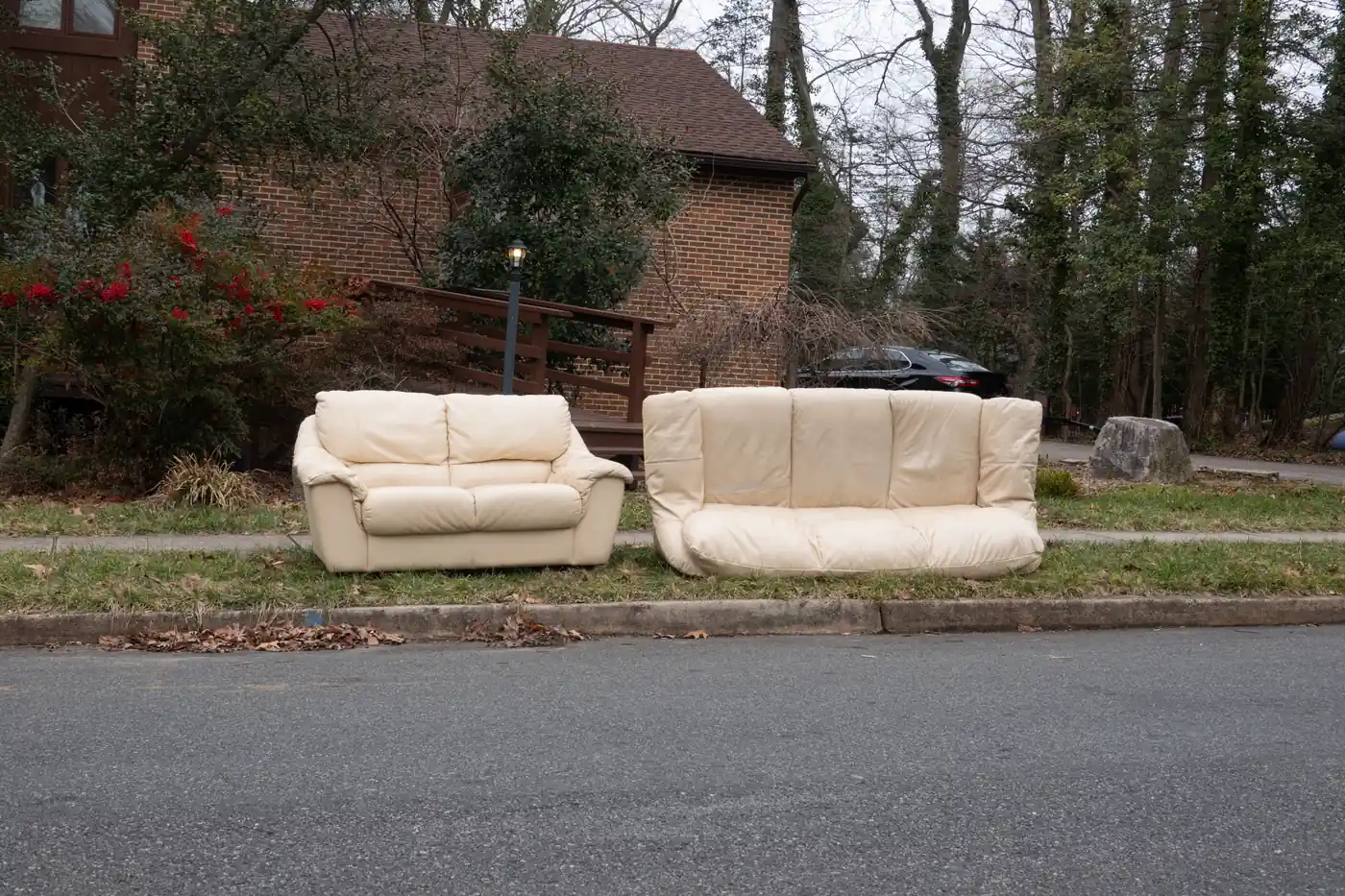
Free, arrange via 311 firstA couch goes next to your black cart on garbage day and the route crew takes it. The sanitation code says to arrange it with your ward superintendent through 311 first, and in practice a 311 request also protects you if the crew skips it. Do not block the alley.
Who qualifies: Single-family homes and buildings with 4 or fewer units that get city garbage service (the black cart). Buildings with 5 or more units use a private hauler; ask your building manager.
How to schedule: Chicago has no scheduled bulk program. The sanitation code says to arrange with your ward's Streets and Sanitation superintendent, through 311 (dial 3-1-1 or 312-744-5000, or 311.chicago.gov), before putting out any large item or extra load. Crews then collect it with your regular garbage route, from the alley or the curb depending on how your block is served.
Limits: No published item limit, but the code prohibits piling large quantities in the alley. One or two items next to the cart on garbage day is routine; a cleanout should be arranged with the ward office first.
Set-out: Place items next to your black cart, in the alley or at the curb, the night before or the morning of your garbage day. Keep the alley passable; obstructing it is a code violation. Remove doors or lids from refrigerators and freezers before setting them out.
Donation pickup in Chicago (usable couches)
FreeChicago’s donation programs accept items in good usable condition: clean upholstered furniture without significant tears or stains, working appliances less than 10 years old, mattresses in good condition (subject to program-specific rules), kitchenware, lamps, and most household goods.
Items typically not accepted: damaged or stained furniture, mattresses with bedbug history or significant wear, appliances that don’t work, particle-board furniture in poor condition, cribs (federal safety regulations have changed), and exercise equipment that requires reassembly. Always call before scheduling if you’re unsure, pickups that find unacceptable items will leave them behind.
Freemoval (free pickups through partner organizations)
FreeFreemoval funds free junk removal and cleanouts for households referred by trusted partner organizations, such as nonprofits, housing programs, and senior services. Families don’t apply directly. A partner submits the request and vouches for the need.
Status in Chicago: Not yet available. Freemoval currently serves metro Atlanta and plans to expand nationwide.
How it works where it operates: One free pickup per household, covering couches, furniture, appliances, and bulk household items within standard LoadUp marketplace service. Funded by LoadUp customer round-ups and direct contributions, spent at standard LoadUp rates.
If you run a nonprofit or housing program in Chicago: you can start the conversation now through the For partners page.
Chicago’s Department of Streets and Sanitation provides free Bulky Item Pick Up through 311 for residents in 1-4 unit buildings, one of the more straightforward city bulk programs. Combined with the city’s electronics and hazardous waste facility, donation pickup, and Cook County’s CHaRM Center, Chicago residents have several options. This page walks through every one.
The Chicago rule for couches: A couch goes next to your black cart on garbage day and the route crew takes it. The sanitation code says to arrange it with your ward superintendent through 311 first, and in practice a 311 request also protects you if the crew skips it. Do not block the alley.
Program basics: No published item limit, but the code prohibits piling large quantities in the alley. One or two items next to the cart on garbage day is routine; a cleanout should be arranged with the ward office first. Place items next to your black cart, in the alley or at the curb, the night before or the morning of your garbage day. Keep the alley passable; obstructing it is a code violation. Remove doors or lids from refrigerators and freezers before setting them out.
What the city will not take: Electronics (banned from Illinois landfills), household chemicals and paint, tires and auto parts, construction and demolition debris, and anything from a building with 5 or more units or a business.
How we checked this. The rules on this page were verified in October 2026 against: City of Chicago: Sanitation Code (residential garbage and bulk pick-up guidance), City of Chicago: Household Chemicals and Computer Recycling Facility, 44th Ward Streets and Sanitation service page (bulk and yard waste practice). Programs change; confirm fees and limits before you go.
Why couches are different from ordinary bulk. Couches are awkward but not regulated like refrigerators or mattresses. The main challenges are: size and weight (sectional couches often exceed cities’ bulk pickup item limits or weight caps), condition (donation programs reject couches with stains, tears, broken frames, or odors), bedbugs (some cities require plastic-wrapping for upholstered furniture, NYC, Cleveland), and frame disassembly (some cities require sectional couches be broken into pieces under specific dimensions for pickup).
Three mistakes that get couches left at the curb:
When free options don’t fit your timeline or your couch is too damaged for donation:
LoadUp paid couch pickup
$80+For households in 5+ unit buildings (excluded from city service), residents who need same-week service, or items the city won’t take, LoadUp offers professional removal in Chicago with upfront pricing. Independent loaders in the marketplace handle pickup, loading, and licensed disposal. Typically 20-30% below national competitors.
What’s included: Loading, hauling, and licensed disposal of your couch. No prep needed beyond pointing out what goes.
Pricing: Starts around $80 for a single item; full-truck pickups range from $300 to $600 depending on volume.
If you can pay for a pickup, your booking helps fund free pickups for someone else. Every paid LoadUp customer can opt in to round up at checkout, and 100% of round-ups go directly to Freemoval’s subsidized jobs.
Book couch pickup in Chicago with LoadUp → Round-up option appears at checkout. Optional, opt-in only.
Rules change at city limits. If you are outside Chicago proper, start with the guide for your own city:
Related guides: the complete Chicago junk removal guide (every item type, city services, hazardous waste, and how to report dumping) and the national couch disposal guide with rules for all 117 cities we cover.
Other free removal guides for Chicago: mattress, refrigerator, washer and dryer, furniture, tv and electronics, dresser, bed frame and box spring, dishwasher.
Does Chicago pick up couches for free?
Yes. Put a 311 request in, then set the couch next to your cart in the alley or at the curb the night before garbage day. Free for homes with 4 or fewer units.
Where can I donate a couch in Chicago?
Chicago’s donation programs accept items in good usable condition: clean upholstered furniture without significant tears or stains, working appliances less than 10 years old, mattresses in good condition (subject to program-specific rules), kitchenware, lamps, and most household goods.
How much does paid couch removal cost in Chicago?
Through the LoadUp marketplace, a single couch pickup in Chicago starts around $80 to $100 with upfront pricing, and full-truck loads run $300 to $600 depending on volume. For households in 5+ unit buildings (excluded from city service), residents who need same-week service, or items the city won’t take, LoadUp offers professional removal in Chicago with upfront pricing. Independent loaders in the marketplace handle pickup, loading, and licensed disposal. Typically 20-30% below national competitors.
My couch is in good condition. What’s the best disposal option?
Donation pickup. Salvation Army, Habitat for Humanity ReStore, Goodwill, and local Furniture Banks all offer free pickup of usable couches in 50+ U.S. metros. Schedule at satruck.org (Salvation Army) or call 1-800-SA-TRUCK. Habitat ReStore: habitat.org/restores. Furniture Bank Network locator: furniturebanks.org. Pickup is typically scheduled 1 to 2 weeks out. The donation also gets you a tax receipt for the fair market value of the couch.
My couch has stains and tears. Will anyone take it?
Donation programs typically reject couches with significant stains, tears, broken frames, or odors. Your remaining options: (1) Free city bulk pickup, most cities accept couches in any condition as long as the frame is intact. (2) Online “Free” listings on Craigslist, Facebook Marketplace, or Buy Nothing groups, some takers will rehab couches that donation programs reject (recovering, repair, etc.). (3) Paid hauler ($70+) for full-service same-day pickup. Don’t leave a stained couch at the curb expecting donation programs to take it, it will sit there.
My sectional couch is huge. Will city bulk pickup accept it?
Depends on your city. Most cities accept sectional couches but require they be broken into pieces under specific dimensions (typically each piece under 6 to 8 ft long, sometimes weight limits apply). San Francisco caps individual pieces at 100 lbs; Columbia SC caps at 40 lbs (which most sectionals exceed). For large sectionals exceeding city limits: (1) Donation pickup if usable, Habitat ReStore especially handles large items. (2) Retailer haul-away with new couch delivery. (3) Paid hauler ($100 to $200 typical for sectionals) with crew and equipment to handle the size.
Can I take a couch to the dump myself?
Yes, most cities operate landfills or transfer stations that accept self-hauled bulk items for a tipping fee ($10 to $50 typical). This is often cheaper than paid haulers if you have a truck. Search “[your city] landfill tipping fee” or “[your city] transfer station.” Bring proof of city residency (utility bill or driver’s license). Some cities charge non-residents 2 to 3x the resident rate.
Is this Chicago page maintained?
Yes. Freemoval maintains this page as a public resource alongside the full Chicago guide. We update it when programs change rules, fees, or contact methods. Last updated October 2026. If you find outdated information, let us know.