3
large items per household during your monthly bulk week, out by 6 a.m. Monday
BOAT-E
batteries, oil, appliances, tires, and electronics are recycled in the same week
1 load
pickup-truck load per visit at a city transfer station for residents
Every route for a dresser in St. Louis, checked in October 2026 against the city’s current rules and the drop-off sites named. The full St. Louis guide covers every other item.
Here is how each route works in St. Louis, starting with the city program and ending with paid pickup.
St. Louis monthly bulk and BOAT-E pickup: dressers
FreeA dresser is one bulk item. Empty it.
Who qualifies: Properties served by the City of St. Louis Refuse Division (city limits only; St. Louis County has separate trash districts).
How to schedule: No appointment. Once a month, during your region's bulk week (find it at stlouis-mo.gov/my-pickup or 314-622-4800), set up to 3 large items out by 6 a.m. Monday. BOAT-E items (batteries, oil, appliances, tires, electronics) are recycled during the same bulk week. Crews have the whole week; report misses to the Citizens' Service Bureau on Friday.
Limits: Up to 3 large items per household per month. City residents can also bring one pickup-truck load to a city transfer station.
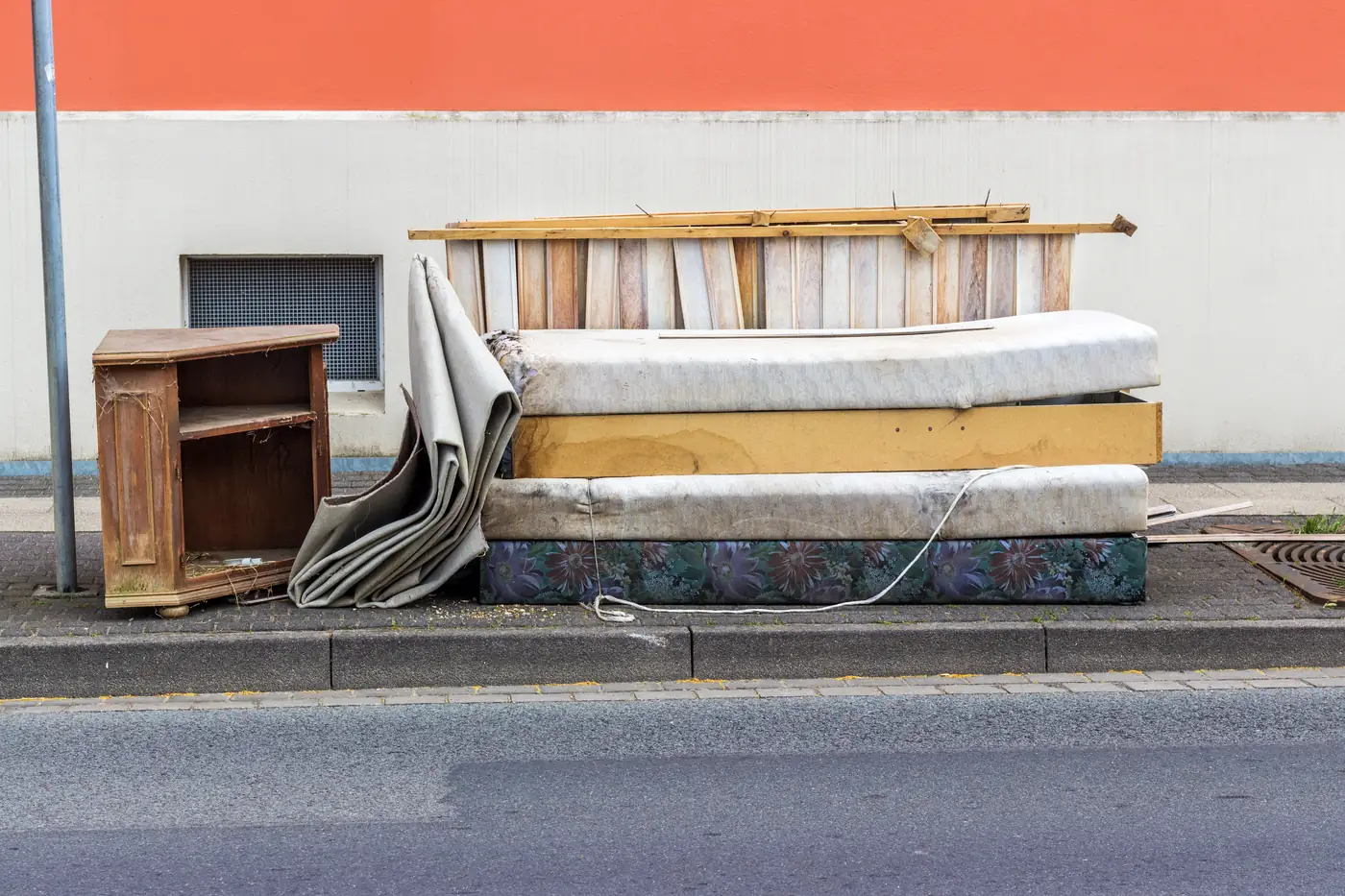
Set-out: Roll-cart homes: at the curb in front of the house. Alley-dumpster homes: in the alley directly behind the house, away from the dumpster, not blocking the alley. Never in or next to the trash container.
Donation pickup in St. Louis (usable dressers)
FreeSt. Louis’s donation programs accept items in good usable condition: clean upholstered furniture without significant tears or stains, working appliances less than 10 years old, mattresses in good condition (subject to program-specific rules), kitchenware, lamps, and most household goods.
Items typically not accepted: damaged or stained furniture, mattresses with bedbug history or significant wear, appliances that don’t work, particle-board furniture in poor condition, cribs (federal safety regulations have changed), and exercise equipment that requires reassembly. Always call before scheduling if you’re unsure, pickups that find unacceptable items will leave them behind.
Freemoval (free pickups through partner organizations)
FreeFreemoval funds free junk removal and cleanouts for households referred by trusted partner organizations, such as nonprofits, housing programs, and senior services. Families don’t apply directly. A partner submits the request and vouches for the need.
Status in St. Louis: Not yet available. Freemoval currently serves metro Atlanta and plans to expand nationwide.
How it works where it operates: One free pickup per household, covering dressers, furniture, appliances, and bulk household items within standard LoadUp marketplace service. Funded by LoadUp customer round-ups and direct contributions, spent at standard LoadUp rates.
If you run a nonprofit or housing program in St. Louis: you can start the conversation now through the For partners page.
St. Louis residents have a generous combination of free services: monthly bulk pickup organized by region, plus 12 free loads per year at the city’s two transfer stations. This page walks through every option in order from free to paid, with the specific rules that apply in St. Louis City.
The St. Louis rule for dressers: A dresser is one bulk item. Empty it.
Program basics: Up to 3 large items per household per month. City residents can also bring one pickup-truck load to a city transfer station. Roll-cart homes: at the curb in front of the house. Alley-dumpster homes: in the alley directly behind the house, away from the dumpster, not blocking the alley. Never in or next to the trash container.
What the city will not take: Railroad ties, construction and remodeling debris (transfer station), household hazardous waste, and regular trash mixed with bulk.
How we checked this. The rules on this page were verified in October 2026 against: City of St. Louis Refuse Division: Bulk and BOAT-E item pickup, City of St. Louis: Residential Collection overview. Programs change; confirm fees and limits before you go.
Why dressers are different from ordinary bulk. Donation programs have tightened furniture standards. Most now refuse particleboard and laminate pieces, anything with a missing drawer or broken runner, and anything with water damage or odor. That eliminates a large share of the dressers people try to donate, which is why so many end up at the curb.
Three mistakes that get dressers left at the curb:
Paid options are for buildings with no bulk service, multi-piece bedroom sets, or a dresser on a third floor with nobody to carry it.
Self-haul to a transfer station
$10 to $30Drawers out, a dresser fits in most SUVs or a pickup. Transfer stations accept furniture by load or weight. Solid wood dressers can also go to a wood recycler in some regions.
Break down particleboard to cut the volume and the fee.
LoadUp paid dresser pickup
$80+For households who can’t wait for monthly bulk Monday or have construction debris not accepted by city services, LoadUp offers professional removal in St. Louis with upfront pricing. Independent loaders in the marketplace handle pickup, loading, and licensed disposal.
What’s included: Loading, hauling, and licensed disposal of your dresser. No prep needed beyond pointing out what goes.
Pricing: Starts around $80 for a single item; full-truck pickups range from $300 to $600 depending on volume.
If you can pay for a pickup, your booking helps fund free pickups for someone else. Every paid LoadUp customer can opt in to round up at checkout, and 100% of round-ups go directly to Freemoval’s subsidized jobs.
Book dresser pickup in St. Louis with LoadUp → Round-up option appears at checkout. Optional, opt-in only.
Rules change at city limits. If you are outside St. Louis proper, start with the guide for your own city:
Related guides: the complete St. Louis junk removal guide (every item type, city services, hazardous waste, and how to report dumping) and the national dresser disposal guide with rules for all 117 cities we cover.
Other free removal guides for St. Louis: mattress, couch, refrigerator, washer and dryer, furniture, tv and electronics, bed frame and box spring, dishwasher.
Does St. Louis pick up dressers for free?
Yes, during your bulk week.
Where can I donate a dresser in St. Louis?
St. Louis’s donation programs accept items in good usable condition: clean upholstered furniture without significant tears or stains, working appliances less than 10 years old, mattresses in good condition (subject to program-specific rules), kitchenware, lamps, and most household goods.
How much does paid dresser removal cost in St. Louis?
Through the LoadUp marketplace, a single dresser pickup in St. Louis starts around $80 to $100 with upfront pricing, and full-truck loads run $300 to $600 depending on volume. For households who can’t wait for monthly bulk Monday or have construction debris not accepted by city services, LoadUp offers professional removal in St. Louis with upfront pricing. Independent loaders in the marketplace handle pickup, loading, and licensed disposal.
Can I put a dresser out for bulk pickup?
Yes in almost every city with a bulk program. Dressers are standard furniture. Confirm item limits and mirror rules in the directory below.
Will Goodwill or Salvation Army take a particleboard dresser?
Rarely. Most donation programs refuse particleboard, laminate, and flat-pack furniture because it does not survive transport and resale. Solid wood pieces in good condition are accepted.
How heavy is a dresser?
A solid wood six-drawer dresser weighs 150 to 250 pounds; a tall chest 100 to 180; a particleboard dresser 80 to 120. Removing the drawers cuts the carry weight by about a third.
How do I break down a particleboard dresser?
Remove the drawers, back the screws out of the cam locks or pry the panels apart, and knock the back panel off. The flat panels bundle for bulk pickup or fit in a car for a transfer station.
Is this St. Louis page maintained?
Yes. Freemoval maintains this page as a public resource alongside the full St. Louis guide. We update it when programs change rules, fees, or contact methods. Last updated October 2026. If you find outdated information, let us know.